Category Archives: The American Experience

Lindsey Graham is an asshole. (But you already knew that.)

Lindsey Graham, R-SC, enjoys a little yuck-yuck during the 2008 Presidential campaign
Sen. Lindsey Graham, R-SC, enjoys a little yuck-yuck during the 2008 Presidential campaign

Leading Republicans have been deploying two equally disingenous, almost laughably self-contradictory arguments to try and defeat health care reform, and especially the desperately-needed “public option” government-administered insurance plan.

First, they argue, it would be unfair to make insurance companies compete with the federal government. Now, coming from Republican folks who argue day and night that the private sector is always superior, always more efficient, this is an interesting paradox. Since it should be self-evident to all us schlubs who are not in Congress, that the current private health insurance system is working so very, very well — indeed, the American health care system is the greatest in the world, despite any stupid statistics (or your personal experiences) to the contrary — it would just be inherently unfair to have to compete with the big, bad federal government, which, after all, never does anything right and…. Well, that’s kind of where I lose them.
Perhaps more insipidly — Senator Graham, do you not avail yourself of your Congressional health plan? — is the argument that any federal insurance program would impose government “bureaucrats” on your personal health care decision making process. Senator Graham hit this week’s Sunday talk show circuit to make just this argument:
(Transcript of “This Week with George Stephanopoulous,” Sunday June 21, 2009.)
 
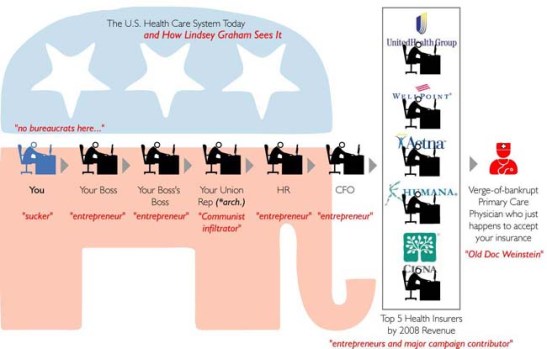
As a real citizen — who over the course of the last 20 years has received private health care coverage through just 2 employers (of my wife’s), but has been placed, with little or no control, into at least 16 different health insurance plans during that same time — I would like to offer Sen. Graham a little visual primer on the U.S. health care insurance system and “bureaucracy.” To wit, I have drawn this little graph for the Senator’s enlightenment:
Senator Graham begs to differ. When I see all those bureaucrats standing between me and my doctor in the diagram above, I’m just being a socialist (or fascist, depending on the day of the week) fellow-traveler. I should know it takes a Senate Republican, who receives generous federal health insurance for himself and his family, to explain to me how there are actually no “bureaucrats” in the diagram above, only hard-working, honest businessmen, doing the best for me and my family. So, after consulting the Republican talking points on health care reform, I realized I had to change the picture. So, thanks to Senator Graham, below is the “real” picture of the American health care insurance system:
 

Of course, while Senator Graham is one of the worst examples, the biggest meaningful obstacle to getting a reasonable public health care insurance option in this country are certain conservative Congressional Democrats. Please write your Congressional representatives, especially if you live in an area represented by one of these fence-sitting Democrats, and let them know that Senator Graham’s view of the public option is the view of a blind, old fool, and that the best way to remove “bureaucrats” from the relationship between you and your doctor is to institute some form of public health insurance program.

Do it before you get sick or go bankrupt. And don’t fool yourself that your flim-flam private insurance is going to keep this from happening to you. Have you actually read your health insurance policy? Do you even know what it covers, honestly? The fact is that the same “entrepreneurs” who brought you sub-prime mortgages, credit card contracts and Bernie Madoff sell you your health insurance. Think there’s much difference? Think again.

Health care was never truly a “market,” in any sensible meaning of that word, to begin with. The time is now to stand up and demand a health care system that works for all of us.

Iran: America’s most dependable mid-East ally?

(Video hat tip: Andrew Sullivan)

I’ve long been of the opinion that once the U.S. State Department and other American foreign affairs powers-that-be got over the long trauma of the Iranian revolution and the “loss” of Iran, that the S’hia Muslims and historical Persians of Iran were generally better suited intellectually and emotionally to be friends of America than the Gulf Arabs of Saudi Arabia. If the very dangerous and potentially incendiary and potentially harmfully destabilizing “popular” uprising today in Iran can, against very long odds, succeed, we may very quickly find the entire arithmetic of mid-East diplomacy changed. The first place that could benefit from that new arithmetic would be Afghanistan, of course.

We must, first and foremost, of course, not be tempted to militarily intervene, regardless of how things turn out. But with a great deal of luck, a new Iranian state could emerge that would be at least as friendly to American interests, while posing some of the same ideological challenges, as today’s China or Vietnam. That would be what, I think the pundits would call, a major inflection point.

The GOP in “Reverse”: “Reverse Class Warfare” and “Reverse Racism”

We have come to the GOP’s end of days, where “class warfare” means marginally lifting the income cap on payroll taxes (or holding the president of AIG’s salary to the same range as that of the President of the United States), and racism means hating on whitey (“no german soldier ever called me honky!”).

Senator Jeff Sessions, R-AL

Senator Jeff Sessions, R-AL, victim of reverse racism

Sen. Jeff Sessions (R-AL), a man who once famously said the only thing that troubled him about the KKK was that some of their members smoked pot, calls Judge Sonya Sotomayor’s comments about her experience as a Latina “troubling,” implying there is some suspect “racialist” tinge to her thinking. Sessions’ remarks about the KKK, a history of referring to the NAACP as “communist” and “un-American,” and similar on-the-record remarks he later claimed were  “jokes,” kept Sessions from winning Senate approval for appointment to the Federal bench in 1986. This, he will tell you, as so-called “racist” Sotomayor sails towards the Supreme Court, is the troubling double-standard that faces down-trodden white Republicans everywhere.

Rush Limbaugh, whose salary is reported to be in excess of $39 million a year, leads the GOP class warfare charge, decrying the progressive income tax as “socialism,” and demonstrating the fiscal sense one would expect from a not-quite-recovered opioid addict, ridicules any suggestion of the need for raising marginal income or capital gains tax rates in the face of historic deficits as “class warfare.” So much for “ask what you can do for your country,” then.

Gordon Gekko, victim of class warfare

Gordon Gekko, victim of class warfare

Card check and union organizing are class warfare. Limiting the average CEO wage at “public” companies to 400 or 500 times the wage of the average worker is class warfare. (How can Citi possibly recruit more “talented” managers at a salary of a “mere $500,000”?) Universal health care and free day care are class warfare. Teachers’ unions are a Platonic ideal of class warfare. And these sentiments are echoed everywhere from the Halls of Congress to the U.S. Chamber of Commerce. The head of the U.S. Chamber of Commerce claims that all Americans are invited to President Obama’s economic “table,” but that the entrepreneur and the “rich” are “the main course.” And Senator Lindsey Graham is typical of Congressional Republicans, calling any proposal for marginally increasing capital gains taxes a type of “class warfare,” whose time has passed:

Class warfare is a time-tested political endeavor whose time has passed. We are in this together. There are about 270,000 people in my State who depend on capital gains income and dividend income. Senator Kyl has gone through, in very detailed fashion, who benefits from capital gains and dividend tax reductions, and there are a lot of seniors.

The world is topsy-turvy, and it’s not surprising that the GOP, backward-facing as ever, should take up the mantle of the rich, white guy as victim. The White Man’s Burden lives, and the GOP will retreat to permanent irrelevancy before they give up their raison d’etre, standing, as they imagine themselves, between the citidal and the hungry horde.

A Star Trek for the Obama Generation?

With its JFK, NASA and Neil Armstrong audio clips, this “teaser” for the new Star Trek neatly melds our childhood’s wanna’-be-an-astronaut nostalgia with the latest manifestation of Star Trek Utopianism. A neat trick. Is the “final frontier” reopening? Or is it already too littered with junk, physical, historical and emotional junk? Still: “Spock’s” voice at the end of this trailer brings tears to my eyes, just like Obama’s.

The battle between our basest and better instincts play themselves out against a background of technological opportunity, in the persons of the young Kirk and Spock. Star Trek, in each iteration, has become steadily more humanized. Has technology? So many great American tropes, spoken and unspoken, present themselves  here. Obama himself, steadily plays both sides of the Kirk/Spock divide; the unflappable guy with all the answers who defiantly takes mustard on his Hell Burger. We’re in a hell of a pickle, Mr. Zulu; but our best days are surely still ahead.

The likely phenomenal box office success of this movie may eventually look like a cultural turning point. (“Inflection point,” I suppose, is the current jargon.) Baby boomers mind-melding with Generation Y in a neoliberal paradise powered by clean nuclear windmills made in America.

Well, maybe for two hours this Saturday night.

Official White House Photo by Pete Souza

Official White House Photo by Pete Souza

(Official White House photo by Pete Souza © Creative Commons, via Flickr White House Channel.)

Torture is Torture

Dick Cheney is running off at the mouth because he’s running scared. And with good reason. The Orwellian double-speak that obfuscated the authoritarian torture state created by the Bush-Cheney administration in the aftermath of 9/11 is collapsing. Dick Cheney is facing serious jail time. He’s especially facing serious jail time if the allegation, bouncing around the Internet now, that “Global War  on Terrorism” suspects were tortured with the sole and specific intent of supporting the thesis of a link between Sadaam Hussein and Al Qaeda in the run-up to the Iraq War, proves true..

Torture is torture. Even John Boehner, that font of ignorance and obstructionism, frontman for the reactionary movement that now calls itself the Republican Party, called it so in a recent unguarded momentTorture apologists like Boehner are arguing that instead of prosecution, we should have a political debate, that this all boils down to a political disagreement. But civilized societies don’t debate the merits of torture any more than they debate the merits of genocide. There simply is no legitimate debate to be had on this issue. It is moot.

Torture is used by authoritarian and tyranical regimes solely to impose arbitrary punishment, or to elicit false confessions. Our American “enhanced interrogation techniques” were directly copied from techniques used by the Chinese and Soviet Communists, during the heart of the Cold War, and from other charming precedents like the torture of Jews and Muslims under Ferdinand and Isabel during the Spanish Inquisition. Even the Orwellian name, “enhanced interrogation techniques,” in another reactionary malapropism worthy of  the creators of political “tea-bagging,” was taken directly from the German, “Verschärfte Vernehmung,” as used specifically and most memorably by the Nazis.

The perpetrators of this crime belong in jail, and it’s supporters should be ashamed. It’s as simple as that. And the perpetrator at the head of it all, the Fuhrer, if you will, of the American torture regime, is Dick Cheney.

[As an aside, PLEASE read all of Andrew Sullivan’s brave, concerted blog reporting on torture, at his “Daily Dish” site.]

The Shower as Class Metaphor

Despite the fact that America has become the most class stratified, the least socially and financially mobile, society in the developed world, we still cannot talk about class transparently. We don’t even have an accepted language for dicussing social and economic class in this country. And merely raising the issue almost assures that you will be characterized as a Leninist class warrior.

Or maybe we have a language emerging. Complete with soap.

This week, social class in America emerged from the shower:

Here’s Ed Schultz, a new MSNBC host, describing his politics:

I’m gonna be the guy who represents people who take a shower after work. I’m gonna be that guy who’s gonna be there for the working folk of America. I’m a staunch supporter of unions. 

And here’s United Steelworkers President Leo Gerard complaining this week on Huffington Post about the structure of the federal bailouts:

The message here could not be more clear: Washington will bailout out those who shower before work but not those who shower afterwards.

So. Stay clean America! I suppose this conversation has to start somewhere. Even in ridiculous and obfuscating metaphor.

Other People’s Money 3 – The Credit Crisis

The real point of this thread is to discuss how, at the heart of the current economic crisis, is our habituation to other people’s money.

What is credit, of course, but other people’s money? Would you really buy the 52-inch flatscreen and the Quatrroporte with your own money? Sure, first  Hyundai, and now GM, are offering to take some of the risk out of buying a new car. But what was the choice to finance these items to begin with, but a way of sharing the risk of the purchase with a bank or finance company? If you knew for certain that you could afford it, shouldn’t you have just bought it?

That’s the crux of the banking and credit crisis as well. Incentives and rewards for top executives at financial service firms have not aligned with the long-term institutional interests of those firms for decades now, undercutting the very philosophical basis of arguments in favor of outsize executive compensation. Alan Greenspan, as we all now know, was “shocked”:

As I wrote last March: those of us who have looked to the self-interest of lending institutions to protect shareholder’s equity (myself especially) are in a state of shocked disbelief. Such counterparty surveillance is a central pillar of our financial markets’ state of balance. If it fails, as occurred this year, market stability is undermined.

Really, dude? You didn’t see this one coming? That the executive overlords in the too-big-to-fail tranche weren’t accountable to anyone but their great-grandchildren? That on the basis of some Ayn Rand-ian fantasy you set a bunch of free radicals loose with trillions of other people’s money and somehow, by the laws of the universe — under some universal law of the origins of specie — it was all gonna’ work out for the best?

At least in the days when financial institutions were held, either by law or by custom, to some size where they couldn’t single-handedly risk trillions of dollars, they were accountable to each other. They’d have to build syndicates, and Bear Stearns wasn’t going to let Salomon Brothers drag them into a deal that smelled. No one on Wall Street wants to change someone else’s diapers.

Likewise the Clintonian and beyond “Fair Isaac Deal” that’s been foisted on the American middle class: In the end, American workers really didn’t need better credit scores, although their entire financial lives were overdetermined by this calculation; what they needed were better wages and a health care system that properly insures against financial calamity in the face of long-term or catastrophic illness. But we too fell sway to the lure of other people’s money.

So, in the coming months, as we slowly unwind this horrible mess, let’s look to these benchmarks:

  • Financial firms need to get smaller, not larger. They need the participation and countervailing force of multiple-firm involvement in deals large enough to threaten, or that might even remotely threaten, the overall stability of financial and credit markets.
  • We need more shareholder reform and activism. Executives at financial firms need to be held to account, every day, for how they handle the corporate assets with which they have been entrusted. This very much includes how much they pay themselves and each other.

Lastly, let’s all wean ourselves off our habt of living off other people’s money. Start a savings account. Pay with cash. You’ll be a better person for it.

P.S., while I’m on a rant, why does this guy (see video) have to be a cyclist? Just as the cycling community started to recover from the negative impressions created by John Kerry?

Complacencies of the Peignoir

Chez Fleisig in Spring

Chez Foley-Fleisig in Spring

(With apologies to Wallace Stevens.)

Crespo Dollar and the Pople are hard at work.

Yet somehow, I envision even our accountant, contingincies of tax season weighing like the world, inspired to refill her Starbucks’, undewing buds suggestive like a second cup of coffee in the warm rain. Her undoing, perhaps? A moment, the office will wait.

Back sections beckon. Woody Allen’s lingerie ads long ago deposed in demotic condominiums, sexy, swanky kitchens met in stainless steel upon the grounds of our most cherished fantasies.

I was just sitting around looking through the magazine section,” … “uh, no, no, I didn’t read the piece on China’s faceless masses, I was checking out the lingerie ads.

Instead, muttering, “that light, that light!” The too soft pitch at the San Siro and David Beckham real time on the back channels of basic cable. What an Italian would do with that body? David in pixels. Da Vincian David in underwear. Our David, bent not bowed, on his axis of fame, the cruciform shape of his testicles our cross to bear. Another cross to bear.

Charles Osgood mutters a last line of doggerel.  We drift from our sinless beds to a last, lukewarm, bit of coffee, barefoot, half naked on the cold kitchen tile, contemplating nothing. And everything. Making hay of the multitasking. Getting it sorted. An hour for this. A place for that.

And with that we rise to our monitors. Books put aside. Dogs petted. Options weighed.

It’s another Sunday morning in America. And there’s work to do.

RIP John Hope Franklin

Slowly, invisibly, irrevocably, African Americans have shaped the American Experience. John Hope Franklin (wiki) joins that pantheon tonight. Charles Nash, W.E.B. Dubois, James Baldwin, Booker T. Washington, Ralph Ellison, Frederick Douglass, Thurgood Marshall, King, Ali, Jimi  (this just a short, insigificant list that could so easily include so many thousands more). Great Americans all.