Category Archives: Politics

Climate Ride

There’s a fantastic, new activist and awareness ride on the U.S. east coast – the Climate Ride – a 5-day, 300-mile adventure from New York City to Washington, D.C.

It’s an interesting ride for many reasons: it includes some urban riding, in addition to covering some of the most historical landscapes in the nation; and it is as much an exercise in political activism and consciousness raising as it is a pure fundraiser. The late-September date also means you riders should be in peak form for making this incredible trip.

I will be writing more about Climate Ride, its objectives and highlights, in the coming days. In the meantime, you can check them out at their home page: http://www.climateride.org/.

Hope Is a Thing that Blings

“It’s premature to conclude the economy has turned,” said CFO Howard Atkins in an interview with The Associated Press.
Atkins did say the bank was seeing a clear benefit from the government’s actions to bring interest rates down. “All I can tell you is, we’re seeing a lot of business.”

$3 billion buys a lot of bling. That’s the net revenue Wells Fargo expects to report for the first quarter. Suddenly, the debate on the economy is focused on whether Wells Fargo’s results are representative, or an anomaly. The President, understandably, is looking on the bright side:

President Obama emerged from a meeting with his senior economic advisers on Friday to say “what you’re starting to see is glimmers of hope across the economy.” But there were also signs of growing tensions between the White House and the nation’s banks over the next phase of the financial rescue.

Currency speculators the world over seem to share the President’s optimism.

April 11 (Bloomberg) — The dollar posted the biggest weekly gain versus the euro in more than two months on optimism the worst of the financial crisis in the U.S. is over.

Still, plenty of people are out there offering more dour assessments.

Wells Fargo announced today $3 Billion in profits. It was fantastic news and it sent the stock market soaring.

However, one thing that didn’t get talked about was why they made so much money.
Wells Fargo CFO Howard Atkins discusses the banks $3 billion reported first quarter 2009 earnings. Atkins hypes the impact of mortgages to the bottom line, due to low interest rates and foreclosure selling no doubt, but shockingly admits at the 7:45 mark that with the writedowns that would have been required by Mark to Market the bank actually lost money on the quarter.

To put it another way, Wells Fargo made money because the government allowed them to play “let’s pretend your assets are worth something”.

But what if that’s exactly what’s going on, and it’s working? What if instead of creating some toxic asset merry-go-round, banks are just allowed to hold toxic assets off their balance sheets long enough for rationality to return, and sensible valuations to emerge?

Just to be clear: I believe the market in mortgage backed securities and their derivatives, is as “undersold” today as it was “oversold” in the middle years of the decade. The herd mentality and “animal spirits”  are every bit as evident in this economic climate as they were in the giddiest days of the Internet, commodities and real estate bubbles. Only everybody’s running to the exits, blocking the aisles, so to speak.

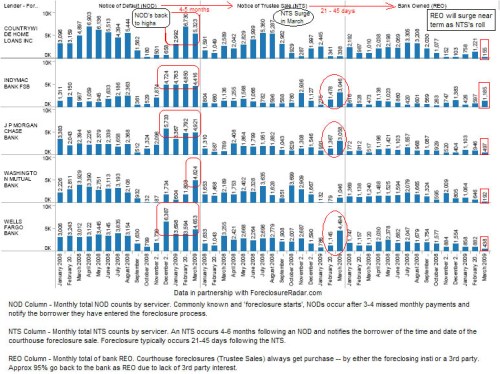
Taking a quick look at “Unbossed’s” graphs of monthly default notices; yeah, sure there’s a spike coming, and defaults on both residential and commercial mortgages are going to double in the coming weeks and month. But double from what basis?

moratoria1 

If the baseline rate of default a year ago was say somewhere in the neighborhood of 1% or 2% (which would have been historically typical), and is anticipated to double based on NODs, then the expected total rate of default will rise to between 2% and 4%. If defaults peak in this range, then portfolios of mortgages will still be worth 75 to 80 cents on the dollar, not the 25 to 30 cents the market values them at today.

Most banks will be able to “ride out” a 2% to 5% rate of default in either commercial or residential mortgages, especially with generous amounts of cheap cash available from the Fed to shore up balance sheets.

In short, everybody has an interest in “staying put” for as long as possible, then capitalizing their losses after the panic subsides. This includes property owners. If the “results” from Wells Fargo are representative – even if they were goosed by new leniency in mark-to-market accounting – it is a sign that the middle-ground bailout and TARP strategy adopted by the Administration is working, It may involve a bit of “accounting magic,” but doesn’t all banking? And in the circumstances, the pessimism that dominates the zeitgeist may in hindsight come to be seen as hysterial (in every sense of the word) as yesterday’s notion that no investment is as safe as real estate.

There’s another trend to look out for. Banks and other financial market makers understand that the current under-valuation of residential and commercial real estate, and the even greater discounts of mortgage portfolios, is the best opportunity for profit they’ve seen in years. They don’t want to partner with other investors or the government, or sell out their interests at all, if they don’t have to. Conditions have been created in which, if they can weather the storm, there is a quick, profitable path to a major windfall.

The bling at the end of the rainbow for many of these institutions is going to turn out to be the very same mortgage-backed securities and collateral debt obligations that got us into the crisis in the first place. When they finally do start trading, they are going to trade significantly below their true long-term asset values. And the smart money is going to snap them up. The Administration is right in limiting the government’s upside potential in all of this, because in the end there is going to be a backlash that buyers and the government took advantage of the original holders of these instruments, and underpaid for them. Put that in your pipe and smoke it, Mr. Roubini.

Westchester Bicycling Summit

Yesterday, David Wilson, President of the Westchester (New York) Cycle Club, and a former political correspondent for Westchester’s Journal News, put together an extraordinary program of cycling and pedestrian advocacy, The Westchester Bicycling Summit, at the Westchester County Civic Center in White Plains.

Mr. Wilson brought together an impressive array of political leaders, cycling advocates, city and transportation planners, researchers and consultants, and cyclists and other interested citizens from across Westchester County. He also announced the formation of a new advocacy group for cyclists and pedestrians in this classically suburban community, The Westchester Biking and Walking Alliance, which will hold its first organizing meeting at 7:00 pm on Monday, May 11, at the Bronxville Library.

Attendees included The Honorable Nita Lowey, congresswoman from New York’s 18th Congressional District; Westchester County Executive Andy Spano; Westchester County Legislator Michael Kaplowitz; President of the League of American Bicyclists, Mr. Andy Clarke; Michael Oliva, Mid-Atlantic Trail Coordinator for the East Coast Greenway; Jackson Wandres, representing the RBA Group, planners and engineers who have consulted with the City of New York and other municipalities on Safe Routes to School and other alternative transportation projects;  Westchester County Planner Lukas Herbert; Julie Bond of the Center for Urban Transportation Research; as well as local representatives of the MTA and New York State Department of Transportation.

The overall message of the day was clear. The writing is on the wall, and the time is right, to rethink how we plan and build transportation infrastructure. Traditional suburbs, like many of the communities in Westchester County, have long been remiss by planning most of their infrastructure with the automobile the only form of transportation taken into consideration. Shockingly, families move to Westchester for the peace and quiet, only to realize, in many communities, that they can’t safely allow their children outdoors to play, or even walk to school, because of the speed and volume of car traffic in their neighborhoods, and the absence of pedestrian and cycling-friendly improvements.

Despite her brave admission that she herself is afraid to ride a bike outdoors, Congresswoman Lowey gave the meeting her sense that the Democratic Congress, and the administration of President Barack Obama, would both look favorably on “green” infrastructure projects, and that she intended to see to it that both stimulus funds and regular appropriations would be made available throughout her district for cyclist and pedestrian friendly improvements such as bike paths, bike routes and new sidewalk construction. County Executive Andy Spano pledged that he would see to it that Bee-Line buses would install and permit use of bike racks, and that he believed that it was both likely and feasible that many of the projects now planned or underway, like the scheduled improvements to the Bronx River Greenway Corridor, would in fact go forward. Associate County Planner Lukas Herbert described significant near-term plans for major improvements to bike paths and bike routes throughout the County, and some of the complexities, successes and frustrations of getting those projects funded and built.

Andy Clarke, of the League of American Bicyclists, gave a fascinating presentation on their Bike Friendly Communities program (a version available here). Among other interesting facts, he noted that 85% of automobile trips nationwide are for recreational purposes, rebutting once and for all the tired common wisdom that automobile-only roadway improvements are “serious,” while projects that include bike and pedestrian friendly elements are somehow frivolous.

One point all interested parties agreed on: We will get the infrastructure we ask for, only if we ask for it. If we want green, walkable and bikeable communities in Westchester County, we as citizens have to step up to the plate and demand them. After some initial hemming and hawing, County Executive Spano confessed that, yes, the squeeky wheel gets the grease, and only citizen interest and participation will motivate legislators – at the municipal, county, state and federal levels – to deliver the funds necessary to build the kinds of bike and pedestrian friendly transportation infrastructure we want and deserve in our Westchester cities and towns.

Children enjoying Westchesters North County Trailway

Children enjoying Westchester's North County Trailway

Here Comes the Sun

According to Jewish tradition, the sun completes its cycle in the universe every 28 years. This morning, coincidentally the morning of the first night of Passover, the sun is said to begin its new cycle.

Late medieval sun prayer, courtesy www.renaissanceastrology.com

Late medieval sun prayer, courtesy http://www.renaissanceastrology.com

Not a particularly religious person, I cannot help but fervently join those celebrating today, in looking forward to new beginnings, to a new dawn, to the world made anew.

Perhaps it is just me, and my personal situation, confronted as I am with the necessity of reinventing my professional life in the teeth of a miserable recession. Sure the choice was mine to walk away from hawking mutual funds and lipstick (as I like to put it), and transition into the public sector, the non-profit sector, the education sector, in the hope of accomplishing something more personally meaningful. But the air itself seems to be full of change and new beginnings: the sudden thaw in America’s relationship with Cuba, a new direction in Middle East diplomacy, radical and yet-to-be-understood changes in both the private and public sector economies.

Novus Ordo Seclorum meets dona nobis pacem. American as apple pie, this protean self, this wish for glorious new beginnings. We call on our g*d or g*ds, whatever their names, for a  long-overdue reinvigoration of civic pride; a chance to restore our lives, our families, our communities; a new opportunity to wage peace, and appreciate our relative prosperity. So whether you find your inspiration today in this ancient rite, in the supplications of the dark, middle days of Easter week, the mindfulness of Pesach, or merely the incrementally higher inclination of a friendly old star in its nearly timeless meridians, let us share, this day, our hopes for a world made anew.

The Shower as Class Metaphor

Despite the fact that America has become the most class stratified, the least socially and financially mobile, society in the developed world, we still cannot talk about class transparently. We don’t even have an accepted language for dicussing social and economic class in this country. And merely raising the issue almost assures that you will be characterized as a Leninist class warrior.

Or maybe we have a language emerging. Complete with soap.

This week, social class in America emerged from the shower:

Here’s Ed Schultz, a new MSNBC host, describing his politics:

I’m gonna be the guy who represents people who take a shower after work. I’m gonna be that guy who’s gonna be there for the working folk of America. I’m a staunch supporter of unions. 

And here’s United Steelworkers President Leo Gerard complaining this week on Huffington Post about the structure of the federal bailouts:

The message here could not be more clear: Washington will bailout out those who shower before work but not those who shower afterwards.

So. Stay clean America! I suppose this conversation has to start somewhere. Even in ridiculous and obfuscating metaphor.

Other People’s Money 3 – The Credit Crisis

The real point of this thread is to discuss how, at the heart of the current economic crisis, is our habituation to other people’s money.

What is credit, of course, but other people’s money? Would you really buy the 52-inch flatscreen and the Quatrroporte with your own money? Sure, first  Hyundai, and now GM, are offering to take some of the risk out of buying a new car. But what was the choice to finance these items to begin with, but a way of sharing the risk of the purchase with a bank or finance company? If you knew for certain that you could afford it, shouldn’t you have just bought it?

That’s the crux of the banking and credit crisis as well. Incentives and rewards for top executives at financial service firms have not aligned with the long-term institutional interests of those firms for decades now, undercutting the very philosophical basis of arguments in favor of outsize executive compensation. Alan Greenspan, as we all now know, was “shocked”:

As I wrote last March: those of us who have looked to the self-interest of lending institutions to protect shareholder’s equity (myself especially) are in a state of shocked disbelief. Such counterparty surveillance is a central pillar of our financial markets’ state of balance. If it fails, as occurred this year, market stability is undermined.

Really, dude? You didn’t see this one coming? That the executive overlords in the too-big-to-fail tranche weren’t accountable to anyone but their great-grandchildren? That on the basis of some Ayn Rand-ian fantasy you set a bunch of free radicals loose with trillions of other people’s money and somehow, by the laws of the universe — under some universal law of the origins of specie — it was all gonna’ work out for the best?

At least in the days when financial institutions were held, either by law or by custom, to some size where they couldn’t single-handedly risk trillions of dollars, they were accountable to each other. They’d have to build syndicates, and Bear Stearns wasn’t going to let Salomon Brothers drag them into a deal that smelled. No one on Wall Street wants to change someone else’s diapers.

Likewise the Clintonian and beyond “Fair Isaac Deal” that’s been foisted on the American middle class: In the end, American workers really didn’t need better credit scores, although their entire financial lives were overdetermined by this calculation; what they needed were better wages and a health care system that properly insures against financial calamity in the face of long-term or catastrophic illness. But we too fell sway to the lure of other people’s money.

So, in the coming months, as we slowly unwind this horrible mess, let’s look to these benchmarks:

  • Financial firms need to get smaller, not larger. They need the participation and countervailing force of multiple-firm involvement in deals large enough to threaten, or that might even remotely threaten, the overall stability of financial and credit markets.
  • We need more shareholder reform and activism. Executives at financial firms need to be held to account, every day, for how they handle the corporate assets with which they have been entrusted. This very much includes how much they pay themselves and each other.

Lastly, let’s all wean ourselves off our habt of living off other people’s money. Start a savings account. Pay with cash. You’ll be a better person for it.

P.S., while I’m on a rant, why does this guy (see video) have to be a cyclist? Just as the cycling community started to recover from the negative impressions created by John Kerry?

The Life We Want. The Blog We Have.

Surfing around from Andrew Sullivan’s Daily Dish yesterday, I followed his link to a blog which appears to be a well-executed version of something I wanted to create years ago, but didn’t have the time for. The Anonymous Liberal is a sustained, well crafted defense of the political principles that guided this country for the better part of the 20th century, but in recent decades suffered derision and slander under relentless assault, first from the radicalizing “New Left,” and, in response, from the radicalizing “Revanchist Right.” Her (or his?) take on current political events are well worth your time.

In the back of my mind, I believe if I could have shown the American masses, through a politically themed blog, that the “liberal” John Kerry was the true conservative in the 2004 presidential race — the kind of thing Anonymous Liberal does so much more effectively, rationally and dispassionately than I ever could — W. would have truly faced an “accountability moment,” and we could have been spared some of the long, national hangover we now face.

Ah, where did the time go?

Instead, working for years under a “creative director” who was an intemperate jerk, exhaustion set in. Certainly one didn’t come home at the end of the day energized to go tinkering in in the proverbial garage of the Internet. Rather, one took one’s comforts in draughts of chilled vodka, the companionship of friends or MSNBC, the contentment of a well-made and (in large part) peaceful marriage.

Now we face the task of not just reinventing ourselves, but reinventing ourselves while the economy around us faces major renovations as well. Who will be better positioned to thrive in the coming uncertain decades, the schoolteacher or the banker? The graphic artist or the writer? The large foundation executive or the entrepreneur? The Congressional aide-de-camp or the assistant vice president?

The life we want is out there. We confront a seeming luxury of choices. Still opportunity narrowly escapes our grasp.

Double-Take of the Week: “Clear and Hold”

…if you had said to us a year ago that– the least of my problems would be Iraq, which is still a pretty serious problem– I don’t think anybody would have believed it.

(President Barack Obama, Sunday, March 29, 2009, on 60 Minutes)

Is this whiplash, or is this love?

With the economy fixed, and the Obama rally well underway in the equity markets, the President turns his attention full time to “Pahk-eh-stan” and Afghanistan.

This is either political stagecraft of unprecedented genius, or a portent of just how screwed we really are by the sheer volume and diversity of the economic, political and social challenges we face.

Or both.

Maybe “clear and hold” isn’t just the latest strategy in the conflict I assume is now being rebranded the Committed War on Al Qaeda (CWAQ, pronounced “Quack”) from the perpetually ineuphonious GWOT, or Global War on Terror. Clear and hold appears to also be an effective strategy against the permanent Republican insurgency.

Having successfully left the likes of Cornyn, Boehner, Jindhal and Cantor sputtering and slack-jawed, reduced to nattering nabobs of Lafferism — left standing surely outside the mainstream as the Kurds will be left standing outside the new walls of Baghdad — the precincts of the economic bailout, TARP, budget, federal reserve and re-regulation, can be left safely in the hands of Leuitenant Geithner. The President has other fish to fry.

Various theories compete to tell us how long a new President can effectively maintain the political capital necessary to help move difficult or innovative legislation. A hundred days? The first term? Through the second year of a second term? One thing is certain: for every commentator who expresses the clear truth that this administration just took office (mumble it to the man, Mos Def! starting around 4:20), there is a cable news talking head with a countdown clock, telling Americans their heads are going to explode if the President doesn’t deliver world peace by the time their taxes are due.

So put me in the camp that gives the President the benefit of the doubt for this sudden, head-spinning turn to foreign policy matters. If the number of adults who are now taking Ritalin is any indication, the American attention span isn’t getting any longer. Movement on multiple fronts is required, and action, even action for the sake of action, is always a tonic to the American mind.

Still, wow, what IS that sudden pain in my neck?

Cramer Caves

On this morning’s Morning Joe, Jim Cramer eats crow again: “I’ve got to admit, [Treasury Secretary Timothy] Geithner is more sophisticated than I first gave him credit for.”

Stablemate Erin Burnett concurs: “There’s no question, Geithner is a guy of real substance.”

Inasmuch as these two can be said to sum up the common wisdom of the equity markets, the equity markets and their gatekeepers, the financial advisors and institutional money managers of the world, are finally warming up to the Obama administration.

This shouldn’t come as too much of a surprise, although it can be beyond frustrating that it takes so long.

Market history is only a fair indicator of market futures. But a quick look at the history of the Dow in the transition years between the Hoover and Roosevelt administrations, the Nixon and Carter administrations, and the Reagan and Clinton administrations, reveals a remarkably similar pattern.

The performance of the Dow in the first weeks and months of each of these transitions to Democratic administrations was consistently abysmal, continuing broad, severe bear markets that began during the last year or years of the preceding Republican administration. But in each of these cases, somewhere between month 3 and month 6 of the new administration, a bull market emerged, creating broad and sustained rallies. A sustained Obama rally could now be emerging; time will tell.

There are two broad implications if this pattern holds true once again. 1) counter to the common wisdom, long-term Republican stewardship of the federal government is bad for equity markets (each one of the multi-term Hoover, Nixon and Reagan administrations ended with horrible bear markets); and 2) there is a knee-jerk bearish reaction to any Democratic presidential victory, which is historically unwarranted, and time after time unwinds into a sustained rally several months into the new administration.

Pass me my rose colored glasses. I’m beginning to think springtime is coming.

Spending? Or Investing?

The debate rages on over Obama’s budget.

For good reasons, the “fiscal hawk” position has become a consensus position in our national politics. But what too many fiscal hawks are missing, is that there IS a difference between “investing” and mere “spending”. If there weren’t, all your 401(k) money would go towards electronic Dura Ace 11-speed upgrades.

(Oh, I forgot: it already does!)

During the campaign, Barack said repeatedly that Bush didn’t just spent too much money, but that, in the end, we got nothing for it. The money was spent recklessly, and didn’t help create any platform (infrastructure, education, etc.) to leverage in the future. (And, IMHO, when the full record becomes available, the amount of criminal spending, i.e., big ticket no-bid appropriations that went to politically connected friends, is going to be shocking; remember the $4 billion that “disappeared” in Iraq?)

Obama’s theory is that future increases in economic activity made possible by investments in meaningful things today (repeat after me: Energy, Education and Health Care; Energy, Education and Health Care) will significantly reduce future structural deficits.

This theory makes at least as much sense as the theory behind massive tax reductions, i.e., that the incentives for American entrepreneurs had been thrown so wildly out of whack by the pre-1982 federal tax code that drastically lowering taxes would actually raise tax revenues. And Obama’s reasoning certainly makes as much sense as the Republican orthodoxy, developed over the past decades by a reductio ad absurdum of that same logic – and without the pre-1982 top marginal tax rates any longer as a pretext – that any and all tax reductions actually increase tax revenues.

Obama’s investment-oriented budget is not simply neo-Keynsian tax and spend liberalism; and neither does it make sense to view it through the same lens as one viewed the last decades’ disastrous “voodoo” economics. Maybe we should call it “401(k) liberalism.”

It’s a new mindset: try to think for once past October 2010 (the end of the proposed budget’s fiscal year), and ask yourself, what should America invest in? If you think a good part of the answer to that question is Education, Energy and Health Care, maybe it’s time to stop whining about the size of the investment, and how much that investment is going to (hopefully, temporarily) take from our extravagant spending pockets. Instead, let’s start a dialogue about our priorities and what returns we expect in the future from our current investment in our government.